Transmission
Your gearbox is capping your remap
A transmission control unit has its own torque ceiling and its own clutch clamping strategy. Leave those standard after an engine remap and the gearbox will quietly limit what you paid for, or slip trying to hold it.
- From
- £199.99
- Typical time
- 2-3 hours
Why it matters
Two control units, one drivetrain
On a modern automatic, the engine ECU and the transmission control unit are in constant conversation. The engine says how much torque it intends to produce. The TCU decides whether the gearbox is willing to accept it.
Raise engine output and leave the TCU untouched, and one of two things happens. Either the transmission requests torque intervention and pulls the engine back during the exact moments you wanted the performance, or it accepts the torque without increasing clutch clamping pressure and the clutch packs begin to slip.
Neither is good. The first means you paid for power you never receive. The second wears out an expensive component. Calibrating both together is what makes the drivetrain behave as one thing.
Engine only
Torque intervention on upshifts, hesitant kickdown, and clutch slip under load.
Engine plus TCU
Torque delivered in full, shifts held firm, clamping pressure raised to suit.
What gets changed
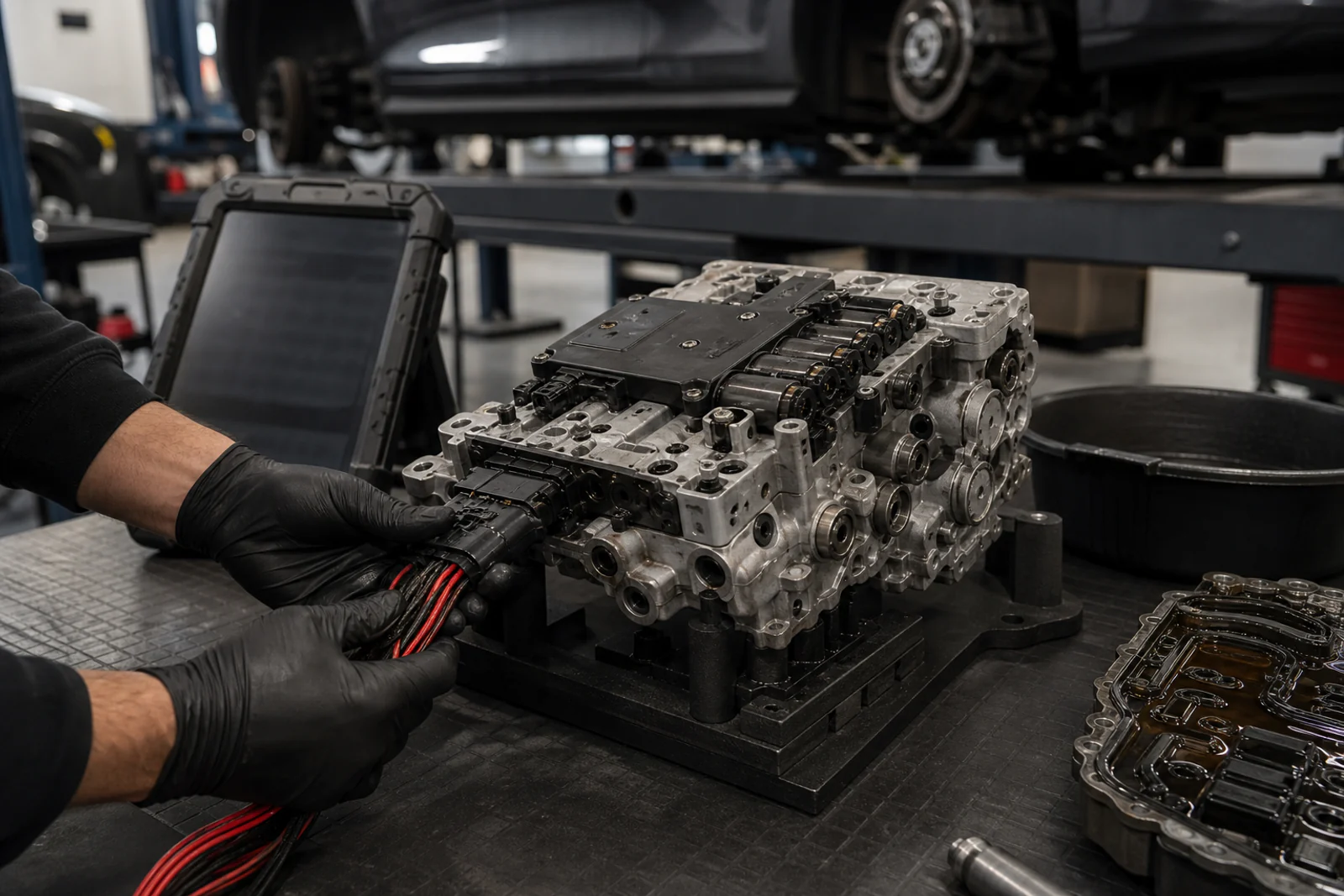
Six areas of the calibration
Not every vehicle gets all six. What we touch depends on the unit, its condition and what you actually want from the car.
Torque limiters
Raised to match the engine calibration, so the gearbox stops requesting intervention during the parts of the rev range you care about.
Clutch clamping pressure
Increased in step with torque. This is the change that protects the clutch packs rather than endangering them.
Shift speed
Shift times reduced so gear changes are quicker and firmer, without becoming harsh enough to be unpleasant on a commute.
Kickdown thresholds
Revised so the gearbox drops a gear when you ask, rather than after a pause and a moment of thinking about it.
Shift points
Adjusted to suit the new torque curve, keeping the engine where it now makes power instead of where it used to.
Launch control
Enabled where the hardware genuinely supports it, with an honest conversation about what repeated use does to a clutch.
Coverage
Transmissions we calibrate
Not sure which unit is in your car? Send us the registration and we will confirm it before you book.
| Unit | Type | Commonly fitted to | Our notes |
|---|---|---|---|
| DQ250 | 6 speed wet clutch DSG | Golf GTI/R Mk5-6, S3 8P, Leon Cupra, Octavia vRS | The most common unit we calibrate. Responds very well to clamping pressure work. |
| DQ200 | 7 speed dry clutch DSG | Golf 1.4-2.0 TSI, Polo GTI, Ibiza, Fabia | Torque limited by design. Gains are real but modest, and we will be honest about the ceiling. |
| DQ381 / DQ500 | 7 speed wet clutch DSG | Golf R Mk7.5-8, S3 8V/8Y, Cupra, Transporter | Strong units with useful headroom for both torque and shift speed. |
| DL382 / DL501 | 7 speed S tronic | A4, A5, A6, Q5, longitudinal Audi platforms | Well suited to raised limits when paired with a matching engine calibration. |
| ZF 6HP / 8HP | Torque converter automatic | BMW, Jaguar Land Rover, Audi, Alpina and others | Excellent gearboxes. Shift speed and lock-up strategy are where the character changes most. |
| Ford Powershift | 6 speed dual clutch | Focus, Mondeo, Kuga, C-Max | We assess clutch and adaptation health carefully before quoting on these. |
Before we quote
A tired gearbox does not get tuned
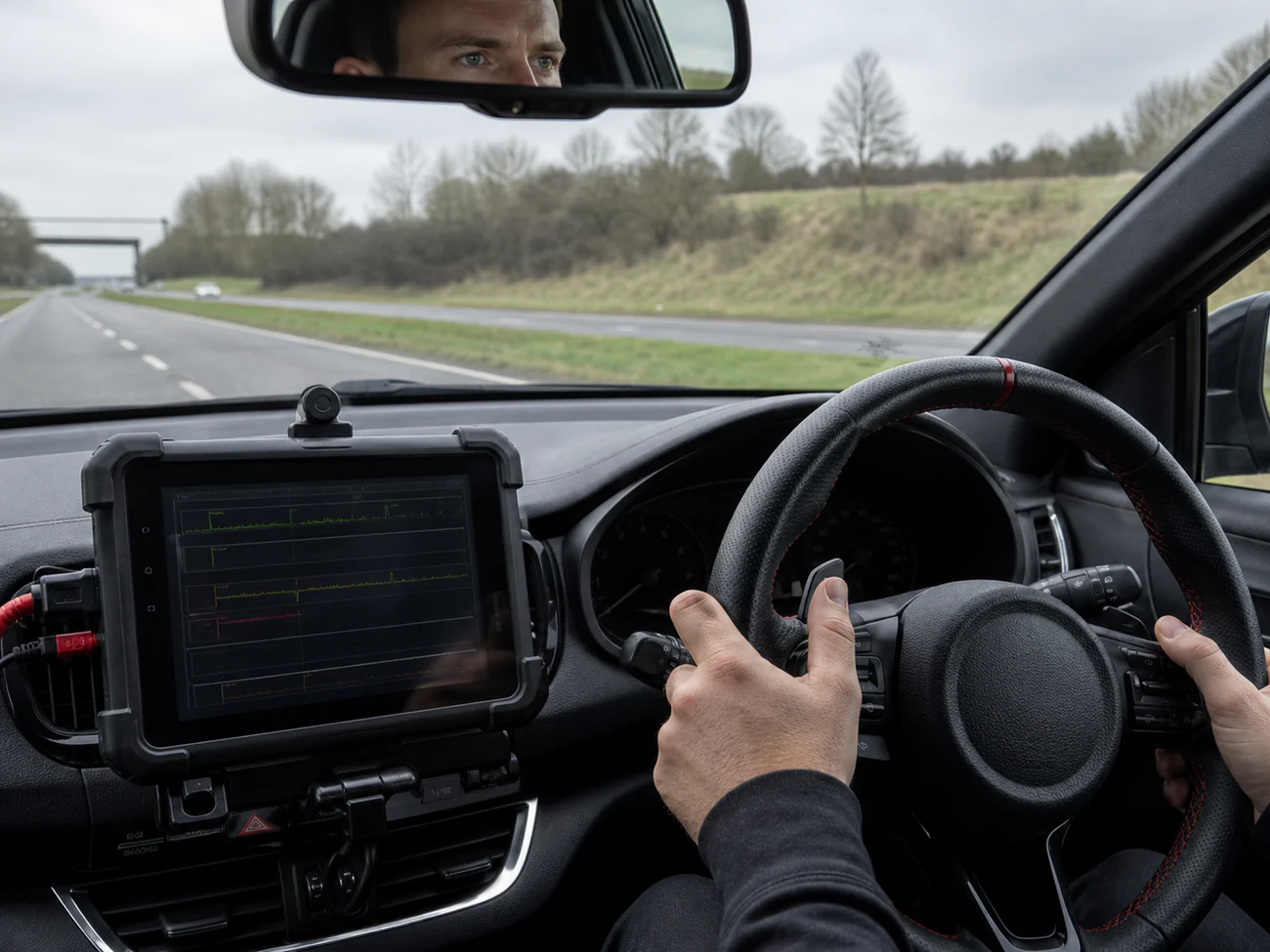
Calibration cannot rescue worn hardware. Every transmission is assessed before we quote, and if the clutch adaptation values or mechatronic health say the unit is near the end of its service life, we will tell you that instead of taking the booking and letting you find out later.
- Clutch adaptation values read and assessed against expected range
- Mechatronic unit fault history and pressure control checked
- Fluid condition and last service interval reviewed
- Slip measured under load on a road test before any changes
- Adaptation values logged again after calibration to confirm the result
Where a fluid and filter service is due, we will usually recommend doing it before the calibration rather than after. Fresh fluid changes how the clutch packs behave, and calibrating on old fluid means calibrating against the wrong baseline.
Questions
Gearbox tuning questions
Reliability, coverage and whether you need this at all after an engine remap.
Do I need TCU tuning if I have had an engine remap?
On a torque-converter or dual-clutch automatic, usually yes. The transmission has its own torque ceiling and clutch clamping strategy. If those are left standard, the gearbox will limit the extra torque or slip under load, so you will not feel what you paid for and the clutch packs will suffer.
Will it make my gearbox less reliable?
Correctly calibrated, no. Raising clamping pressure in step with torque is what protects the clutch packs. Problems come from raising torque without touching the transmission, or from generic files that ignore clutch adaptation values.
Which gearboxes can you work on?
VAG DSG and S tronic (DQ200, DQ250, DQ381, DQ500, DL382, DL501), ZF 6HP and 8HP as fitted to BMW, JLR and others, and Ford Powershift. If you are not sure which unit you have, send us the registration and we will confirm.
Can launch control be enabled?
On many DSG and S tronic vehicles, yes, where the hardware supports it. We will tell you honestly whether your specific gearbox and clutch will tolerate repeated use of it before enabling anything.
Related work
The rest of the drivetrain
Custom Performance Remapping
The other half of the job. On an automatic these two really do belong in the same visit.
Read moreAdvanced Vehicle Diagnostics
Adaptation values, mechatronic health and slip are all diagnostic work before any calibration.
Read moreDPF & Emissions Servicing
On diesel automatics, shift strategy affects how readily the vehicle reaches regeneration conditions.
Read more
Match the drivetrain
Already remapped? Your gearbox may be holding it back
Send the registration and tell us what has been done to the engine. We will confirm which transmission you have, whether it is worth calibrating, and what it costs.