
Emissions
Clean the filter. Then fix what blocked it.
A blocked DPF is a symptom. Cleaning it without finding the cause buys you a few months and the same bill again. We restore flow, then diagnose why it happened, and we keep your vehicle road legal while doing it.
- From
- £279.99
- Typical time
- 3-5 hours
Where we stand
We do not remove DPFs, and we will not pretend otherwise
Removing or disabling a diesel particulate filter on a road-going vehicle is an automatic MOT failure and an offence under the Road Vehicles (Construction and Use) Regulations. It can also invalidate your insurance and makes the vehicle very difficult to sell honestly.
Workshops that offer it are handing you a problem that surfaces at your next test, not solving one. Everything on this page keeps the filter in place and the vehicle compliant. If that is not what you are looking for, we are not the right workshop for you, and we would rather say so now.
The mechanism
Why filters block in the first place
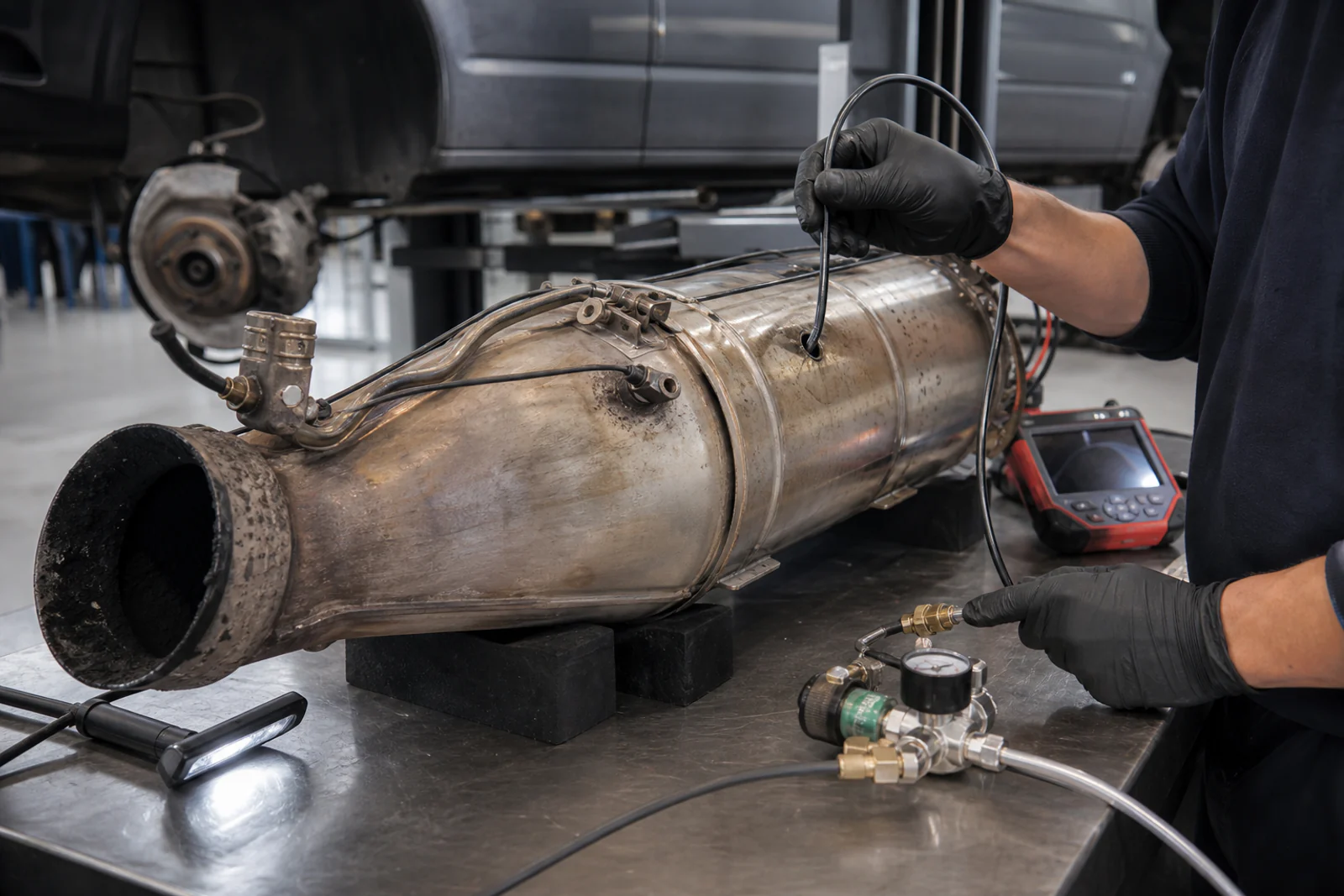
A diesel particulate filter traps soot in a honeycomb of ceramic channels. As it fills, exhaust flow restricts, and the engine management measures that restriction as a pressure difference across the filter.
When soot builds past a threshold, the ECU runs a regeneration: extra fuel is injected late in the cycle to raise exhaust temperature to roughly 600 degrees, which burns the trapped soot away. This needs sustained load and speed, which is why it usually happens on a longer run without the driver ever noticing.
Everything goes wrong when that cycle cannot complete. Short journeys, repeated cold starts, a fault raising soot production, or simply switching the engine off mid-regeneration. Soot then climbs past the point where the vehicle will attempt a regeneration at all, the light comes on, and eventually it goes into limp mode.
What we do
Measure, clean, diagnose, verify
In that order. Cleaning a filter without diagnosing the cause is the most common reason customers arrive here having already paid someone else.
Measure first
Differential pressure, calculated soot loading and ash loading read from the ECU, along with regeneration history. If ash is past the manufacturer limit, cleaning will not save it and we will tell you before you spend anything.
Clean and regenerate
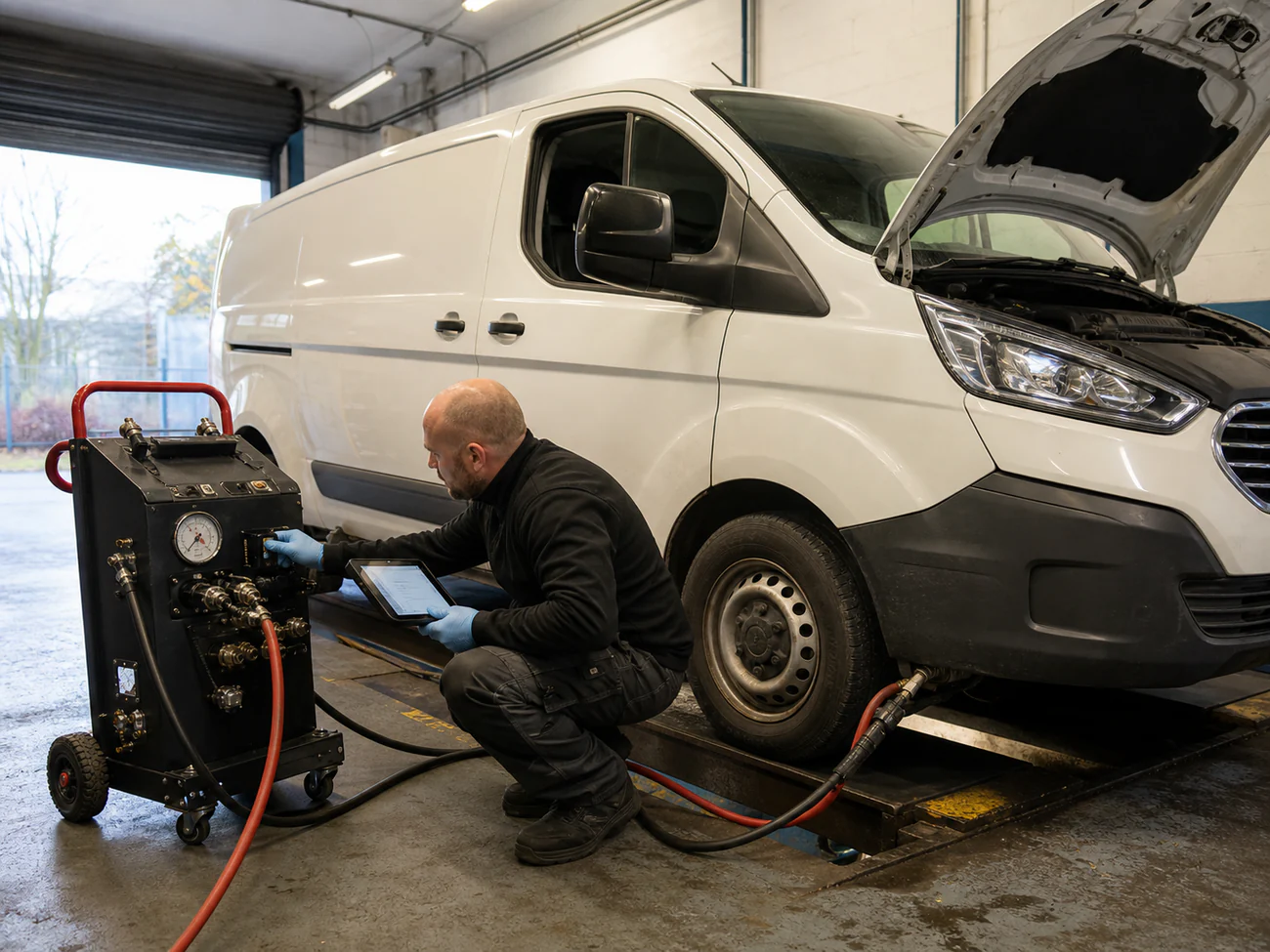
On-car chemical cleaning through the filter, followed by a controlled forced regeneration at operating temperature. The filter stays on the vehicle throughout.
Find the cause
EGR operation, injector back-leakage and correction values, differential pressure sensor accuracy, boost and turbo control, and glow plug function all tested.
Verify on the road
Road tested with live data logged, confirming pressure has returned to specification and that the vehicle can now complete its own regeneration unaided.
Root causes
Six reasons a filter blocks
One of these is almost always behind a DPF that has blocked more than once. Finding which is the difference between fixing it and repeating it.
| Cause | What is happening | How we address it |
|---|---|---|
| Short-journey duty cycle | The vehicle never gets hot enough for long enough to complete a regeneration, so soot accumulates faster than it burns off. | Driving advice, and where suitable an economy calibration that reduces low-load soot production. |
| Failing or sticking EGR valve | Excess exhaust gas recirculated into the intake dramatically increases soot loading and coats the inlet tract. | Valve tested, then cleaned or replaced, and the inlet manifold inspected for build-up. |
| Leaking or worn injector | Over-fuelling puts unburnt diesel into the exhaust, loading the filter and diluting the engine oil. | Injector back-leakage and correction values tested, then reconditioning or replacement. |
| Faulty differential pressure sensor | The ECU is told the filter is blocked when it is not, or clear when it is. Either way regeneration happens at the wrong time. | Sensor and its pipework tested against actual measured pressure, then replaced if out of tolerance. |
| Interrupted regenerations | Switching the engine off mid-regeneration is one of the most common causes we see. The cycle never completes, and soot keeps climbing. | Regeneration history read from the ECU, forced regeneration completed, and how to spot one explained. |
| Ash loading at end of life | Ash from oil additives cannot be burned off. Past the manufacturer limit no amount of cleaning will restore the filter. | Measured and shown to you. If it is genuinely finished we will say so rather than take money for cleaning it. |
Keeping it clear
What you can do afterwards
Most of what determines DPF life is how the vehicle gets used and serviced. None of this is complicated, and it is the advice we give every diesel owner who leaves the workshop.
Give it a proper run
Twenty to thirty minutes at sustained motorway speed roughly every fortnight gives the vehicle the conditions it needs to regenerate on its own.
Learn what a regeneration feels like
Idle speed rises slightly, the cooling fan runs harder, and there is often a faint hot smell. If you notice it, try not to switch off until the run is finished.
Use the correct low-ash oil
Low SAPS oil to the manufacturer specification, changed on time. Cheap oil at extended intervals is a direct route to ash loading.
Act on the light early
A DPF warning is asking for a run. Ignoring it until the vehicle drops into limp mode turns a free fix into a workshop bill.
Questions
DPF questions
Legality, repeat blockages, whether a filter can be saved, and how to stop it happening again.
Do you remove DPFs?
No. Removing or disabling a diesel particulate filter on a road vehicle is an MOT failure and an offence under the Road Vehicles (Construction and Use) Regulations. Everything we do keeps the filter in place and the vehicle road legal.
My DPF keeps blocking. Is cleaning going to fix it?
Cleaning restores flow, but if a fault caused the blockage it will simply happen again. That is why every DPF job here includes diagnosis of the underlying cause, most often a failing EGR valve, a leaking injector, a faulty differential pressure sensor or a duty cycle that never lets the vehicle complete a regeneration.
How do I know if my filter can be saved?
We measure differential pressure and soot and ash loading before quoting. Soot can be burned or washed out. Ash cannot, and once ash loading is beyond the manufacturer limit the filter needs replacing. We will show you the readings either way.
What can I do to stop it happening again?
Give the vehicle a sustained run at motorway speed roughly every fortnight so it can complete a regeneration, use the correct low-ash oil at the correct interval, and act on the DPF light early rather than driving on with it lit.
Related work
What DPF work usually involves
Advanced Vehicle Diagnostics
Finding the cause behind a blocked filter is diagnostic work, and it is included in every DPF job here.
Read moreCustom Performance Remapping
An economy calibration reduces low-load soot production on vehicles doing short runs.
Read moreGearbox & TCU Tuning
On automatics, shift strategy affects how often the engine reaches regeneration conditions.
Read more
Get it measured
Before you replace a filter, find out whether you need to
Bring the vehicle in and we will measure differential pressure, soot and ash loading and show you the numbers. If the filter can be saved we will save it. If it cannot, you will know why.